
E-invoicing in the EU: where it is mandatory and how the systems differ
A dated guide to all 27 EU countries: issuing, receiving and reporting, national systems, cross-border examples and the adopted ViDA timetable.
General information, not legal or tax advice. Rules and implementation dates checked on 22 October 2026. The country overview concerns ordinary business invoicing; establishment, transaction type and sector exceptions can change the result.
A supplier emails a perfectly readable PDF. The customer can open it, approve it and pay it. Yet the supplier may still have failed to issue the electronic invoice required by law. Elsewhere in Europe, the same delivery method may be acceptable—or the customer may already have a right to request a structured file even though there is no universal issuing mandate.
Europe is moving towards structured invoicing, but it does not yet operate one invoice portal or one domestic timetable. The useful questions are who must issue, who must receive, what must be reported, and through which channel. This guide answers those questions country by country. For the Romanian workflow and a worked deadline calculation, see RO e-Factura in practice. Read this article in Romanian.
1. What makes an invoice electronic?
In everyday language, a PDF sent by email is an electronic invoice. In the European structured-invoicing framework, the decisive feature is that software can read and process the invoice's fields automatically. A picture of an invoice does not provide that structure. Neither does an arbitrary XML file with the right filename.
- EN 16931 defines the meaning and business rules of a core electronic invoice: seller, buyer, invoice identifier, amounts, tax information and other fields.
- UBL and UN/CEFACT CII are structured syntaxes in which those fields can be expressed. A national implementation can add applicable requirements.
- Peppol provides a governed exchange network and interoperability specifications. It is not an EU tax authority or a universal replacement for national platforms.
- A hybrid invoice can combine a readable PDF with embedded structured data. A qualifying ZUGFeRD/Factur-X document is different from an ordinary PDF or a PDF with an unrelated attachment.
The European Commission's e-invoicing overview explains the structured approach; its technical guidance on EN 16931 covers conformance. National format and delivery requirements still need to be checked.
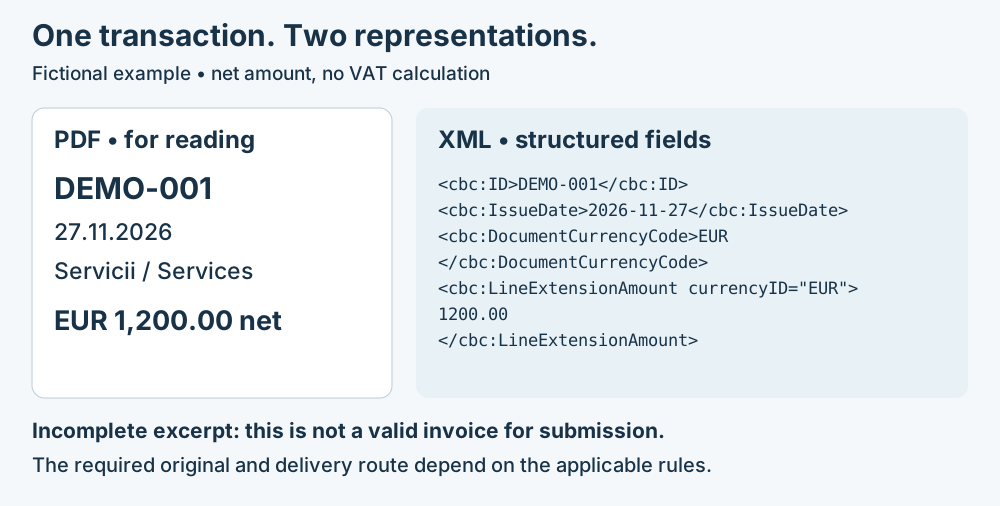
Download the one-page PDF comparison. It is an educational worksheet, with fictional amounts and an incomplete XML excerpt, rather than a specimen ready for tax submission.
| Item | Useful for | What still needs checking |
|---|---|---|
| Scanned invoice or ordinary PDF | Human reading and supporting evidence | Whether the required structured original exists and was sent through the correct route |
| Structured XML | Importing invoice fields without retyping | Correct syntax, business rules, tax treatment, identifiers and national profile |
| Qualifying hybrid PDF/XML | Human reading and machine processing in one package | Whether its embedded data and profile meet the applicable mandate |
| Tax reporting service | Sending required invoice or transaction data to an authority | Whether it also delivers the legally required invoice to the customer |
| Exchange network or platform | Routing invoices and returning technical statuses | Recipient registration, national coverage, archiving and responsibility for failures |
A successful technical validation establishes neither that the goods arrived nor that the bank account is genuine. Those remain purchasing and payment controls.
2. Three duties that are often confused
B2B means business-to-business, B2G business-to-government, and B2C business-to-consumer. Each can have a different rule within the same country.
- Issuing: the supplier creates and transmits the invoice in the prescribed form.
- Receiving: the customer must be able to accept that form, sometimes before its own issuing deadline starts.
- Reporting: invoice or transaction data goes to the tax authority. Reporting can accompany exchange or operate separately.
France and Germany illustrate why this matters: a business can need a working receiving process while still benefiting from an issuing transition. Hungary illustrates another distinction: invoice-data reporting includes paper invoices, so extensive reporting does not itself prove that every customer receives structured XML.
For public procurement, Directive 2014/55/EU, particularly Article 7, requires covered public buyers to receive and process compliant electronic invoices. National law determines additional supplier obligations and wider scope. It would therefore be inaccurate to describe the directive alone as a blanket EU-wide duty for every supplier to issue every invoice electronically.
3. The EU country comparison: what applies now?
The following tables cover all 27 Member States. Dates describe domestic B2B arrangements unless stated otherwise. “No general mandate identified” does not mean no rules: public procurement, a buyer's statutory request, a contract, or fiscal reporting may still require action. The country names link to the relevant authority or Commission profile.
Obligations already applying
| Country | Issuing and receiving | Route / reporting | Important scope point |
|---|---|---|---|
| Belgium | In-scope domestic B2B issuing and receipt since 1 January 2026. | Structured exchange, normally through Peppol. | A PDF alone is insufficient; a small-business VAT exemption does not automatically remove the obligation. |
| Croatia | Covered VAT-registered businesses issue and receive from 1 January 2026; the relevant non-VAT group receives in 2026 and issues from 2027. | Electronic exchange plus fiscal reporting. | Receiving an invoice and fiscalising its data are distinct responsibilities. |
| France | Receipt for all covered businesses from 1 September 2026; large/intermediate companies issue then, SMEs and microbusinesses from 1 September 2027. | Approved platforms; separate transaction reporting for other covered flows. | A smaller supplier may still be in its issuing transition while already needing to receive structured invoices. |
| Germany | Receipt since 1 January 2025. Issuing transition through 2026; qualifying smaller issuers and certain EDI arrangements through 2027. | EN 16931-compatible formats such as XRechnung or qualifying ZUGFeRD; email can be a delivery route. | Receiving and issuing dates differ. Exceptions include qualifying small-value invoices and small-business issuers. |
| Greece | First issuing wave from 2 March 2026; second wave starts 2 November 2026, after this review date. | Authorised channels and myDATA-related reporting. | The second-wave transition into January 2027 is conditional; myDATA reporting alone does not describe every invoicing duty. |
| Italy | Broad domestic B2B/B2C use of SdI, introduced in 2019 and subsequently extended. | FatturaPA XML through Sistema di Interscambio. | Check current transaction exceptions; historical lists of exempt small-business regimes can be obsolete. |
| Poland | Issuing phases began 1 February and 1 April 2026; receipt from 1 February. | KSeF national system. | A limited transition for low monthly invoiced sales continues through 2026; it is not a general SME exemption. |
| Romania | Covered domestic B2B invoices through RO e-Factura; issued B2C invoices also reported. Public-sector rules apply separately. | XML meeting RO_CIUS requirements through the Ministry of Finance system. | The 2026 deadline is five working days for covered B2B/B2C transmission; specific supplier and transaction exceptions matter. |
Three transitions deserve particular attention:
- Germany: the extended issuing transition for smaller suppliers uses prior-year turnover of no more than EUR 800,000. A supplier's permission to use a transitional format does not remove its customer's receiving duty. The BMF FAQ also identifies exemptions and the treatment of EDI.
- Poland: the first issuing wave used 2024 gross sales above PLN 200 million; the low-volume transition uses invoiced monthly gross sales of no more than PLN 10,000. These are statutory thresholds, not interchangeable “large” and “small” business labels. Receipt began on 1 February 2026. KAS launch guidance.
- Greece: the first wave concerned businesses above EUR 1 million of 2023 revenue. For the second wave, check the conditions attached to the transition through 31 January 2027, rather than simply moving the start date to February. AADE decision A.1197/2026.
Adopted dates that are still ahead
| Country | Issuing and receiving | Route / reporting | Important scope point |
|---|---|---|---|
| Latvia | General domestic B2B structured invoicing scheduled for 1 January 2028. | Structured invoice exchange; public-sector reporting already has earlier dates. | The former 2026 B2B date was postponed. Do not apply a public-sector date to all private invoices. |
| Slovakia | Covered domestic VAT payers issue from 1 January 2027; receipt capability also concerns other business recipients. | Peppol-based delivery and national reporting arrangements. | Preparation in 2026 is not the same as a general obligation already applying in 2026. |
| Slovenia | Adopted domestic B2B exchange obligation starts 1 January 2028. | Service providers, Peppol or compliant direct exchange; B2G already established. | Domestic business scope must be distinguished from foreign-customer and consumer invoices. |
| Spain | Issuing/receipt from 6 October 2027 above EUR 8 million turnover; 6 October 2028 for the remaining covered businesses. | Regulated interoperable exchange; invoice/payment-status reporting has its own phases. | The October 2026 order started the implementation clock. This is distinct from Veri*Factu and SII. |
Spain illustrates the importance of a precise trigger: the implementing order's entry into force on 6 October 2026 starts the one- and two-year periods for issuing and receiving. The subsequent invoice/payment-status obligations have their own timetable. A software supplier advertising readiness for Veri*Factu is not, for that reason alone, offering the whole forthcoming B2B exchange process.
Buyer rights, reporting and countries without a general current mandate
| Country | Issuing and receiving | Route / reporting | Important scope point |
|---|---|---|---|
| Austria | No general domestic B2B mandate identified; federal B2G requirements apply. | Federal e-Rechnung route; private arrangements vary. | A federal-government invoice and a private-business invoice follow different requirements. |
| Bulgaria | No general domestic B2B mandate identified; covered public buyers receive compliant invoices. | Public-procurement facilities and voluntary business exchange. | An implementation discussion does not itself create a B2B deadline. |
| Cyprus | No general domestic B2B mandate identified; public-buyer receipt obligations apply. | EN 16931 receipt in the relevant public-procurement scope. | Buyer acceptance does not establish a universal supplier issuing mandate. |
| Czechia | No general domestic B2B mandate identified; public-sector receipt rules apply. | Structured formats and public-sector electronic channels. | Agree the supported format and route with the recipient. |
| Denmark | Public-sector invoicing is established; covered digital bookkeeping systems must support e-invoicing. | NemHandel/Peppol and bookkeeping-system capabilities. | A software capability requirement is not a universal duty to exchange every B2B invoice electronically. |
| Estonia | Since July 2025, registered e-invoice recipients can require compliant structured invoices, subject to the permitted agreement rules. | Buyer-choice model and exchange operators. | A buyer's registered status matters; this is not unconditional mandatory issuing for every transaction. |
| Finland | Public entities and qualifying businesses have a statutory right to request a compliant e-invoice. | EN 16931 invoice on request; established exchange operators. | The business definition uses turnover above EUR 10,000; the right is not an unconditional all-invoice mandate. |
| Hungary | Broad invoice-data reporting; no equivalent universal structured B2B exchange mandate identified. | NAV Online Számla reporting, including data from paper invoices. | Reporting invoice data does not necessarily replace the invoice delivered to the customer. |
| Ireland | Announced phases: November 2028 for large VAT corporates, November 2029 for relevant businesses trading across EU borders. | Planned e-invoicing and digital reporting reform. | These are announced future implementation plans, not a general B2B duty already operating in October 2026. |
| Lithuania | No general domestic B2B mandate identified; public-sector invoicing uses SABIS. | SABIS for relevant public-sector flows; tax registers are a separate layer. | A tax-data filing duty is not the same as a general private-customer exchange mandate. |
| Luxembourg | No general domestic B2B mandate identified; public-procurement supplier obligations have been phased in. | Peppol/public-sector submission routes. | Identify whether the customer and contract fall within the public mandate. |
| Malta | No general domestic B2B mandate identified; covered public buyers must accept compliant invoices. | Public-sector EN 16931 acceptance. | The public buyer's ability to receive is distinct from mandatory electronic issuing by every supplier. |
| Netherlands | No general current B2B mandate; September 2026 policy announcement targets domestic e-invoicing in July 2030 and reporting in July 2031. | Public-sector e-invoicing already exists; domestic reform announced. | Government policy intention must be distinguished from enacted and applicable implementing law. |
| Portugal | No general domestic structured B2B exchange mandate identified; public-sector rules and transitions apply. | Invoice-data reporting and certified-software requirements are separate obligations. | Do not confuse tax reporting or software certification with a requirement to send every customer structured XML. |
| Sweden | No general domestic B2B mandate identified; public-procurement e-invoicing requirements apply. | Peppol is an established public-sector route. | An ongoing policy inquiry is not an enacted general B2B obligation. |
The Commission's country collection is useful for comparing national architecture. Its profiles have different update and validation dates. For an operational deadline, use the current national legislation and authority guidance linked above, rather than a map that labels each country simply “mandatory” or “voluntary”.
4. What changes under ViDA?
VAT in the Digital Age (ViDA) has been adopted. It is not a pending proposal. From 1 July 2030, its cross-border B2B digital-reporting framework changes the way covered intra-EU transactions are invoiced and reported. It does not create a single European invoice website, and it does not mean businesses can ignore national mandates until 2030. European Commission: ViDA.
How the EU rules become applicable — short timeline
The package includes a directive and regulations. A directive requires Member States to implement its required outcome in national law; a regulation is directly applicable on its relevant application date. Adoption, entry into force and the date a business must change its process can therefore be different dates.
- 11 March 2025: Council adoption of the ViDA package.
- 14 April 2025: entry into force; this did not activate every future business obligation at once.
- 1 July 2030: the main covered intra-EU B2B digital-reporting changes apply.
- 1 January 2035: alignment date for the qualifying legacy domestic reporting systems covered by Article 6(5) of the adopted directive. This is a specific transition, not a blanket permission for every country to delay until 2035.
Sources: Commission implementation overview; Directive (EU) 2025/516, Article 6.
| Today | Adopted direction | Useful preparation now |
|---|---|---|
| National domestic mandates have different scopes and routes | Greater reliance on standardised structured invoicing and transaction-level reporting | Keep reliable structured invoice data, not just PDF images |
| Cross-border VAT reporting commonly relies on periodic processes | Covered intra-EU B2B transactions enter the ViDA digital-reporting framework from July 2030 | Record tax identifiers, transaction dates and correction references consistently |
| Different national systems and service providers coexist | Common European requirements still operate alongside national implementation | Choose exportable data and documented interfaces; verify each required country route |
| Receipt, approval and payment are often conflated in software | Legal reporting and internal payment decisions remain different events | Keep separate statuses and evidence for each event |
For a business operating in several countries, preparation begins with a matrix of the transaction types, customer identifiers and delivery routes it actually needs. One successful domestic connection does not demonstrate coverage of all those flows.
5. Three transactions, three different answers
A Belgian supplier invoices a Belgian business
A fictional consultancy invoices EUR 1,200 net for project support. If both parties and the transaction fall within the Belgian domestic B2B mandate, sending only a PDF does not complete the required process. The supplier needs compliant structured exchange; the buyer needs a receiving route and an internal owner who handles incoming documents. A PDF can accompany the invoice for convenience.
The operational test is straightforward: can the supplier identify the recipient, deliver through the agreed compliant route, see a failure if it occurs, and retain the structured record? A “send PDF” button answers only part of that question.
A German business invoices a French customer
The customer's French address does not automatically turn a cross-border invoice into a domestic French B2B invoice. Equally, German domestic rules should not simply be copied onto a transaction outside their domestic scope.
Before selecting a route, the parties must establish their relevant places of establishment, the nature and place of supply, whether an establishment participates in the supply, and any separate reporting duties. They should then agree the supported format and customer reference. The place-of-supply and VAT analysis comes before the file-format decision.
A Romanian supplier invoices a Romanian public institution
This is a public-sector workflow, not merely two companies emailing accounts departments. The supplier must determine the applicable B2G/public-institution requirements, include the required references, and use RO e-Factura when required. The institution still checks the contractual basis, delivery and payment approval. The Ministry of Finance's seal does not perform those checks for it. The Romanian companion article explains the original XML, corrections, CPV information and document retention.
6. A practical implementation checklist
A small company does not need an elaborate transformation programme. It does need an owner for each step and a way to notice failure.
| Task | Suggested owner | Evidence that it works |
|---|---|---|
| Determine legal scope and effective date | Finance with tax adviser | Written country/transaction classification, including exceptions |
| Confirm recipient identifiers and purchase-order references | Sales or purchasing | Test recipient and accepted references, verified with the counterpart |
| Configure authorisation and access | IT/system administrator | Authorised company connection, limited permissions, renewal owner |
| Test issue, receipt, rejection and correction | Finance and software provider | Successful test records plus a deliberately rejected example |
| Route invoices to a responsible reviewer | Department/project owner | Invoice reaches the person who can confirm delivery |
| Separate approval from payment | Finance/payment approver | Approved invoice and independently verified payment details |
| Export and restore the records | Records owner/IT | Original structured files, statuses and attachments can be restored without the original operator |
When comparing software, ask for an actual demonstration using one ordinary invoice, one correction and one failed transmission. Check whether the advertised product creates, transmits, receives, reports, archives, or merely displays invoices. “E-invoicing support” can mean any combination of those functions.
A useful internal register includes the invoice identifier, supplier, buyer, date, payable amount, transmission status, recipient availability date where relevant, reviewer, dispute status, due date and recorded payments. Keep those statuses separate: downloaded is not approved, and approved is not paid.
7. Further reading and review date
This edition was checked on 22 October 2026. The country tables link directly to their supporting national sources or official country profiles; the EU timetable links to the adopted text. The next review should revisit the November Greek phase, January 2027 transitions and any enacted changes following national announcements.
For the Romanian obligations, exceptions and worked examples, continue with RO e-Factura in practice. Versiunea în limba română.
A note on organising the records
WorkStudio can bring invoices retrieved through an authorised Romanian RO e-Factura connection into a shared register with their original files and supporting documents. Teams can review and approve invoices, record payments, follow outstanding balances and export records for their accountant. Automatic retrieval can be enabled for a connected company. These functions concern that Romanian connection and the internal workflow. See WorkStudio packages for the available invoice services.
Legal and tax information notice. This article provides general educational information based on the sources and review date shown. It is not legal, tax or accounting advice for a particular business or transaction. National scope, exceptions, implementation measures and subsequent amendments may affect the answer. Before changing invoicing, tax reporting, payment or retention procedures, check the applicable current law and obtain appropriate professional advice. Illustrative businesses and amounts are fictional; the downloadable example is not a compliant invoice for submission.
Enable JavaScript to use reading progress and usefulness ratings.