
RO e-Factura in practice: obligations, deadlines and handling invoices
Who must use RO e-Factura, five-working-day calculations, corrections, penalties, retention and an office checklist, with practical examples and legal sources.
General information, not legal or tax advice. Romanian rules checked on 22 October 2026. The examples are fictional; the correct treatment depends on the parties and the transaction.
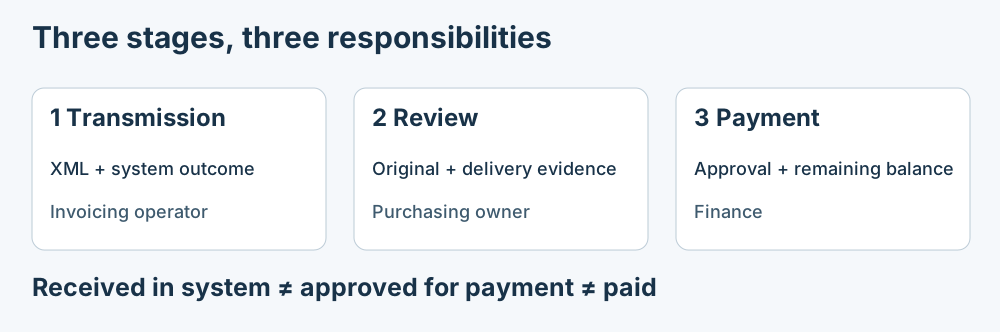
RO e-Factura changes more than the file attached to an email. It establishes a structured transmission process, a legally relevant original and a moment when an invoice is considered communicated. The company still has to decide whether the invoice belongs to it, whether the goods or services were delivered, who approves payment and how the records will remain available.
Two changes are particularly important in 2026: the covered B2B/B2C transmission period is five working days, and a specific exception now applies to suppliers identified for tax purposes by CNP, the Romanian personal identification number. Older guidance about five calendar days or automatic registration of all CNP-identified suppliers from June can therefore lead to the wrong answer.
This guide follows the invoice from legal classification to payment evidence. For other Member States, see E-invoicing in the EU. Citiți articolul în română.
1. Who must use RO e-Factura?
B2B means business-to-business, B2C business-to-consumer, and B2G business-to-government. Start with the parties, their tax status and the place of supply. Being a taxable person is not the same as being registered for VAT: a business using a VAT exemption can still fall within e-Factura rules.
| Situation | Main rule | Example and qualification |
|---|---|---|
| Domestic B2B: supplier and customer established in Romania | Covered invoices must be transmitted through RO e-Factura, irrespective of VAT registration | A Romanian company invoices another Romanian company for office equipment; check the transaction and statutory exceptions, not just whether VAT is charged |
| Issued B2C invoices for supplies taking place in Romania | Covered suppliers must transmit these invoices from 1 January 2025 | A consumer requests an invoice for a service; reporting the invoice does not automatically deliver it to the consumer |
| Public procurement / relevant public-institution purchases | The B2G and public-institution provisions apply | A contractor invoices a public authority; the public contract and required references still matter |
| Romanian-established supplier, customer not established here but registered for Romanian VAT | Article 10(1¹) extends transmission to covered domestic supplies | A foreign company's Romanian VAT number can make this an important category; the supplier must also deliver the invoice to the customer under the Fiscal Code |
| Supplier identified for tax purposes by CNP | Specific exception from the listed mandatory routes applies from 1 June 2026; voluntary participation is possible | Check the actual fiscal identifier; “self-employed” or “PFA” alone does not establish the exception |
| Cross-border transaction | Classify the place of supply, establishment and any express exception first | A foreign postal address does not, by itself, prove inclusion or exclusion |
Sources: OUG 120/2021, Articles 5, 9¹, 10, 10¹ and 10¹⁰; Law 88/2026, Articles III–IV.
Exceptions worth checking before configuring the software
- The exception for qualifying cash-register receipts that meet simplified-invoice conditions is not an exemption for every document called a simplified invoice.
- The ordinance identifies an exception for the relevant intra-Community goods supplies where the Romanian-established beneficiary communicates a VAT number from another Member State.
- Article 10³ covers specified transactions outside the scope of VAT or amounts outside the taxable base where there is no obligation to issue an invoice. Both parts of that test matter.
- Natural-person farmers using the special regime in Article 315¹ of the Fiscal Code have a specific exception, with voluntary participation available.
- Certain diplomatic/international transactions and foreign cultural institutes have specific treatment.
- The former temporary relief for some non-VAT associations and foundations ended in 2025. “Non-profit” is not a general current exemption for economic activities.
- Security/classified public contracts have their own exclusions; an ordinary public works invoice should not be treated as excluded merely because its customer is a public body.
The detailed provisions are in OUG 120/2021, Articles 6 and 10–10¹⁰. The CNP exception concerns the supplier's fiscal identification. It should not be confused with a consumer's decision not to disclose a personal identification number.
Example: a consumer who does not provide a CNP
A Romanian business issues an invoice to an individual for a household service. If the individual supplies no fiscal identification code, Article 10¹(4) requires the prescribed identifier of 13 zeros. The company should not demand a CNP merely to make e-Factura transmission possible. It must also send or otherwise deliver the invoice to the consumer under the Fiscal Code, subject to the optional-register provision. Sending it to ANAF is not a substitute for ordinary customer delivery.
Conversely, the B2C reporting rule concerns invoices issued. It does not create a new universal duty to issue a full invoice for every retail receipt where the Fiscal Code does not require one. OUG 120/2021, Article 10¹.
2. What is the original, and what does the seal prove?
The electronic invoice is structured XML complying with the applicable European standard and RO_CIUS, Romania's national usage specification. The legally relevant original is the XML accompanied by the Ministry of Finance's electronic seal. Keep the downloaded package and its associated identifiers intact.
The seal attests receipt in the system. It does not certify that the work was executed, that the buyer accepts the price, that the bank account is safe, or that VAT deduction is justified. A readable PDF is valuable for review, but does not replace the required original. The communication date is the date the invoice becomes available for the recipient to download, not the date someone eventually opens it. OUG 120/2021, Article 4(1)–(7).
Before transmission, verify at least:
- the invoice number and issue date, plus the supply/advance information required for the transaction;
- seller and buyer identifiers, including the correct company rather than another group company;
- the description, quantities, prices, discounts, tax categories, rates or exemption/reverse-charge references, and totals;
- contract, order and payment information required by the applicable rules and commercial arrangement;
- the currency and any legally required tax amounts or currency conversions.
For public-procurement invoices, the ordinance additionally requires the relevant CPV codes—the common public-procurement classification codes—from 1 January 2025. A contract reference and supporting progress statement should also be reconciled with the authority's contractual requirements. An accepted XML does not replace certification of work performed. Sources: OUG 120/2021, Article 4(2) and (2¹); Fiscal Code, Article 319.
Download the PDF/XML comparison worksheet. The EUR 1,200 net service amount illustrates data representation only; the worksheet omits the complete tax and identification fields needed for a valid invoice.
3. How to calculate the five-working-day period
For the covered B2B transmission duty, Article 10(7) now sets five working days from the invoice's issue date, with an outer limit of five working days from the legal issuing deadline in Fiscal Code Article 319(16). Article 10¹(2¹) provides the corresponding B2C transmission rule. These changes apply from 1 January 2026, following OUG 89/2025.
There are two clocks:
- Issue the invoice on time. Under Article 319(16), the usual rule for the operations it covers is no later than the 15th day of the month following the tax point; the provision also addresses advances. Establish the tax point and any special rule first.
- Transmit it on time. Count the applicable five working days from issue, while respecting the statutory outer limit. Issuing a late invoice does not restart a fresh unrestricted legal period.
The ordinance expressly refers to Regulation 1182/71 on periods, dates and time limits. Exclude the day of the triggering event; working days exclude Saturdays, Sundays and public holidays. Sources: OUG 120/2021, Articles 10(7) and 10¹(2¹); OUG 89/2025, Article X; Fiscal Code, Article 319(16).
Worked calendar: invoice issued on Friday, 27 November 2026
Assume a covered domestic B2B invoice is issued on time for a service supplied that day. There is no earlier outer-limit deadline. The Romanian public holidays on 30 November and 1 December fall between issue and transmission.
| Date | Treatment | Count |
|---|---|---|
| Friday 27 November | Issue date; triggering day excluded | — |
| 28–29 November | Saturday and Sunday | — |
| Monday 30 November | Romanian public holiday | — |
| Tuesday 1 December | Romanian public holiday | — |
| Wednesday 2 December | Working day | 1 |
| Thursday 3 December | Working day | 2 |
| Friday 4 December | Working day | 3 |
| 5–6 December | Saturday and Sunday | — |
| Monday 7 December | Working day | 4 |
| Tuesday 8 December | Fifth working day | 5: transmission deadline |
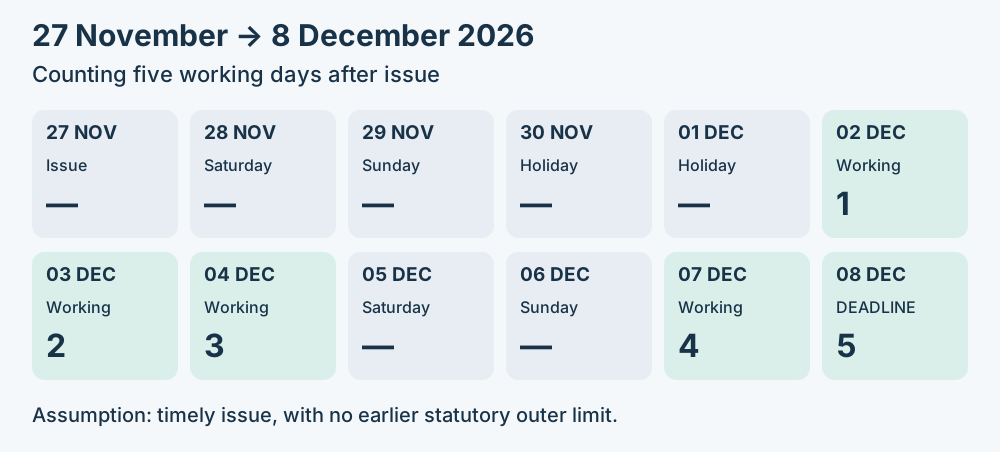
The holiday basis is Labour Code, Article 139. An internal target of transmitting promptly, rather than on day five, leaves time to resolve rejected files and authorisation failures. Sending an XML which the system rejects is not the same as obtaining the successful system result.
The late-issue trap
Suppose an operation's legal issuing deadline under Article 319(16) was 15 October 2026, but the business issues the invoice on 23 October. The five-working-day outer limit following 15 October expires on 22 October, assuming no applicable intervening holiday. Counting afresh to 30 October from the late issue would conceal the original breach. Finance needs both the tax-point/issuing deadline and the transmission date in its control process.
The five-day analysis above addresses the cited B2B/B2C provisions. Public-sector invoicing also requires checking its particular legal and contractual workflow; do not postpone a contractually required submission simply because a B2B example uses five days.
4. Rejection, disagreement and correction are different events
| Situation | Meaning | Appropriate next step |
|---|---|---|
| System rejects the XML | It did not pass the relevant system checks | Read the error, correct the file and retransmit; retain the outcome and monitor the legal deadline |
| System accepts, buyer disputes the quantity or price | Technical receipt succeeded; the commercial disagreement remains | Record the objection and notify the issuer through the available message process; resolve the contractual issue |
| An invoice already communicated needs correction | The original is part of the record | Issue the correction under Fiscal Code Article 330 and transmit the corrective document through RO e-Factura |
| Same invoice arrives by email and through the system | Two representations may concern one liability | Match supplier, number, date and amounts; do not create two payment obligations |
A communicated invoice cannot simply be returned or deleted through the system. Article 4 provides for objections and correction; Article 330 distinguishes documents not yet sent from invoices already communicated. Preserve the relationship between the original and the correction. OUG 120/2021, Article 4(8)–(10); Fiscal Code, Article 330.
Example: a supplier invoices ten units at EUR 100 net each, but the accepted delivery is eight units. The buyer flags the EUR 200 net difference and keeps the delivery record. Once the correction is agreed, the supplier uses the appropriate corrective document, referencing the original; any associated tax correction follows the actual transaction. Editing the PDF to show eight units would leave the structured original unchanged and break the audit trail.
5. Which penalties apply?
The law distinguishes using the required system from sending an invoice late. It is misleading to describe every error as either a 15% penalty or a fixed fine.
| Offence | Statutory consequence | Important distinction |
|---|---|---|
| Issuer fails to use RO e-Factura for an invoice within the Article 10(1) duty | Fine of 15% of the invoice's total value | The precise offence concerns the required system route |
| Recipient receives and records an invoice covered by that provision outside the required system | Fine of 15% of the invoice's total value | Receiving and recording are the statutory elements; apply the actual legal scope and exceptions |
| Failure to observe the relevant B2B transmission deadline, or the specified B2C transmission failure | RON 5,000–10,000 for large legal-person taxpayers; RON 2,500–5,000 for medium; RON 1,000–2,500 for other legal persons and natural persons | The law groups one or more invoices with transmission deadlines in the same calendar month; do not present this as an automatic fine multiplied by every invoice |
These are statutory amounts in Romanian currency, not fictional pricing examples. Other offences, including specific public-institution and enforcement situations, have their own provisions. The public buyer's payment restrictions also require attention. Sources: OUG 120/2021, Articles 13¹ and 13².
If accounts receives only an emailed PDF for an in-scope domestic B2B purchase, it should request and reconcile the proper system document and refer the accounting treatment to the responsible accountant. A colleague's statement that “the supplier will upload it later” is not evidence of successful transmission.
6. Downloading is not a retention policy
Under the system procedure, the relevant XML files and error messages are available for download for 60 days from publication in the system, after which archived documents can be requested. This access window is different from the company's legal retention period. Ministry of Finance Order 1365/2021, procedure; ANAF explanation of retrieval after 60 days.
Article 25 of the Accounting Law sets the general retention period for accounting registers and supporting documents at five years, calculated from 1 July of the year following the close of the financial year in which they were drawn up. For a calendar-year business, a document drawn up in financial year 2026 therefore has that clock starting on 1 July 2027, running through 30 June 2032. This is a baseline calculation, not a disposal authorisation: applicable asset, funding, litigation or other retention requirements must also be considered. Accounting Law 82/1991, Articles 23 and 25.
A workable invoice record should preserve:
- the original XML and the Ministry of Finance seal/download package;
- the relevant upload/download identifiers and status evidence;
- a readable rendering for everyday review;
- the contract/order, delivery or acceptance evidence and approvals;
- linked corrective invoices and correspondence;
- payment records and a clear indication of any remaining balance.
Keep a recoverable backup and test an export independently of the employee who set up the connection. A successful backup notification is less useful than a demonstrated ability to restore the original and its supporting documents. Access permissions should survive staff changes without sharing a former employee's credentials.
7. A small-office workflow with named responsibilities
| Step | Suggested owner | Completion evidence |
|---|---|---|
| Classify customer, transaction and exception | Finance/accountant | Documented B2B/B2C/B2G treatment and relevant identifiers |
| Create and review invoice data | Billing colleague, reviewed by finance | Correct parties, dates, line items, tax treatment and required references |
| Transmit and monitor the result | Assigned invoicing operator, with a deputy | Successful result; rejected items visible and assigned for correction |
| Retrieve incoming invoices regularly | Accounts payable or authorised automation owner | Originals saved, retrieval failures noticed, duplicates reconciled |
| Confirm delivery or work performed | Purchaser/project manager | Order, delivery note or certified progress statement reconciled |
| Approve and make payment | Authorised approver and payment operator | Approval and independently checked beneficiary details |
| Record payments and reconcile | Accounts payable/accountant | Paid amount, remaining balance and any dispute separately recorded |
| Retain and test recovery | Records owner with IT | Export/restore test including XML, seal and supporting evidence |
Example: an invoice has an illustrative payable total of EUR 1,000. A EUR 400 payment leaves EUR 600 outstanding. The invoice can be technically received and commercially approved while still only partly paid. Marking it simply “done” hides that distinction. An internal register should show the original payable amount, payment dates, amounts, remaining balance and any disputed portion.
Automatic retrieval reduces missed downloads; it does not decide whether an expense is legitimate. Keep a visible exception queue for rejected transmissions, unavailable authorisations, unexplained duplicates and invoices with no responsible reviewer.
8. Dated changes and the sources behind this edition
| Effective date | Previous position | Current rule reflected here | Source |
|---|---|---|---|
| 1 January 2026 | The relevant transmission deadline used five calendar days | Five working days, with the statutory outer limit and the European counting rules | OUG 89/2025, Article X; OUG 120/2021, Articles 10(7) and 10¹(2¹) |
| 1 June 2026 | Earlier guidance expected CNP-identified suppliers to enter the mandatory regime after temporary relief | Article 10¹⁰ exempts these suppliers from the listed mandatory routes and allows voluntary participation | Law 88/2026, Articles III–IV |
The consolidated OUG 120/2021 is the main source for scope, the original, transmission and penalties. Read it with the Fiscal Code, especially Articles 278, 319 and 330, the system procedure and the Accounting Law.
For the broader comparison and the adopted European timetable, see E-invoicing in the EU. Versiunea română.
A note on the daily workflow
WorkStudio can retrieve invoices through an authorised RO e-Factura connection and keep the original files with supporting documents in a shared register. Teams can review and approve invoices, record payments, follow balances and export records for their accountant. Automatic retrieval can be enabled for the connected company. These functions support document handling and internal review; issuing and transmitting new invoices remain a separate workflow. See WorkStudio packages for the available invoice services.
Legal and tax information notice. This article provides general educational information, checked against the cited sources on the date shown. It is not legal, tax or accounting advice and does not determine the treatment of a particular invoice. Establishment, place of supply, tax status, exceptions, contractual terms and later legislative changes can affect the answer. Before relying on a deadline, exception, correction, penalty or retention calculation, verify the current applicable provisions with the responsible professional. Illustrations are fictional; the downloadable worksheet is incomplete and must not be submitted as a fiscal invoice.
Enable JavaScript to use reading progress and usefulness ratings.