
Within budget but out of cash: understand the project cash-flow gap
A profitable project can still need funding before the customer pays. Build a dated forecast and distinguish costs, commitments, invoices and cash.
A project can have a positive expected margin and still be unable to pay next week's supplier. Margin compares income and costs under the relevant accounting approach. Cash flow asks when money actually enters and leaves the account. Timing connects them, but they are not interchangeable.
RICS's Cash Flow Forecasting practice information addresses the preparation and use of construction cash-flow forecasts. RICS, second edition.
A worked example: EUR 20,000 margin, EUR 15,000 shortfall
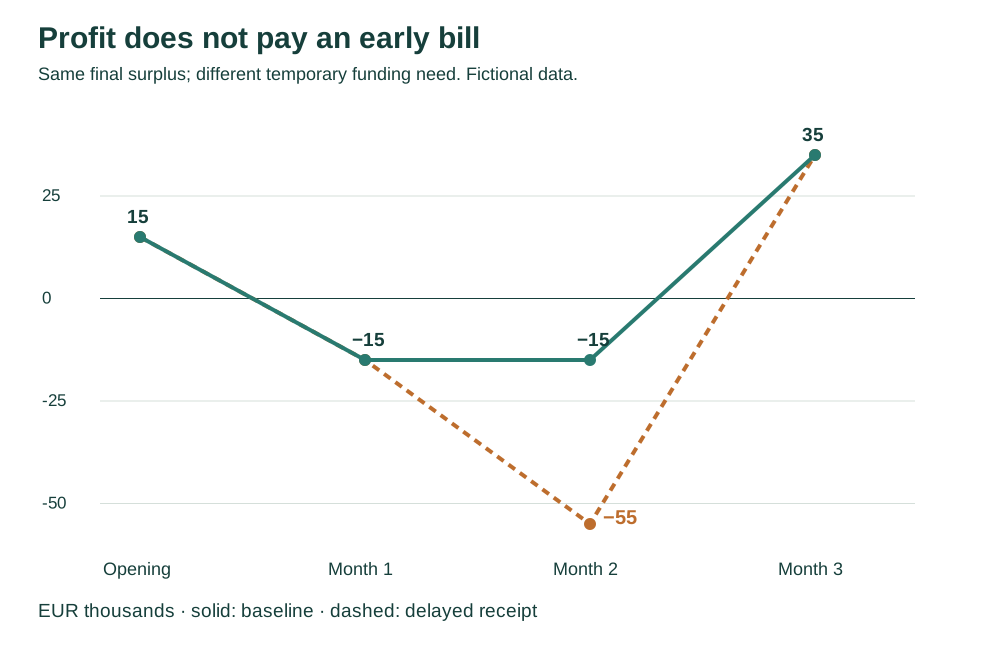
Assume a fictional project with customer receipts of EUR 120,000 and total project payments of EUR 100,000. For simplicity, costs and payments ultimately match, all receipts are collected and there is no VAT, financing cost, retention or other business activity. Opening cash is EUR 15,000.
- Month 1: receipts EUR 0; payments EUR 30,000; closing cash minus EUR 15,000.
- Month 2: receipts EUR 40,000; payments EUR 40,000; closing cash minus EUR 15,000.
- Month 3: receipts EUR 80,000; payments EUR 30,000; closing cash EUR 35,000.
The simplified project surplus is EUR 20,000 and ending cash is EUR 15,000 + EUR 20,000 = EUR 35,000. Nevertheless, without additional funding or a legitimate change to payment timing, the first month's payments cannot all be made from the opening cash.
A negative forecast is a funding requirement, not a bank balance you can assume the bank will permit. Monthly totals can also conceal a larger mid-month shortfall. A receipt on the last day cannot fund a payment due on the fifth.
| Period | Opening cash | Receipts | Payments | Closing cash |
|---|---|---|---|---|
| 1 | 15,000 | 0 | 30,000 | −15,000 |
| 2 | −15,000 | 40,000 | 40,000 | −15,000 |
| 3 | −15,000 | 80,000 | 30,000 | 35,000 |
Keep four views connected
Budget is the approved allocation against which the project is controlled. Commitments are obligations such as purchase orders or subcontracts. Costs and invoices describe performance and billing under the relevant recognition rules. Cash records actual receipts and payments.
Suppose a EUR 12,000 order is placed in January, delivered in February and paid in March. It affects the commitment view in January; its accounting treatment depends on delivery and recognition rules; its cash payment appears in March. Copying EUR 12,000 into a cash forecast in every month would count the same outflow three times.
Use a remaining-to-pay amount for each commitment, linked to invoices and payments. Reconcile partial payments and credit notes. An order's full value and its already-paid invoices must not both remain as future cash requirements.
Forecast from events and terms
For incoming cash, follow the chain: work completed, evidence prepared, application submitted, assessment or certification, invoice where required, and expected payment date. “We finished the work” does not establish when the customer will pay.
For outgoing cash, identify deposits, delivery payments, payroll, subcontractor terms, taxes and other material dates. Add retention release and disputed items explicitly where relevant. Do not quietly treat uncertain receipts as available cash merely because the contract allows a claim.
Maintain a short rolling weekly view for near-term decisions and a monthly view for the remaining project. Record assumptions beside dates: “customer confirmation received” differs from “historical average” and from “optimistic target”.
Stress-test the dates, not only the final total
Move the example's EUR 40,000 receipt from month 2 to month 3 while leaving payments unchanged. Closing cash at month 2 becomes minus EUR 55,000. The final project surplus is unchanged, but the temporary funding need is much larger.
Other useful scenarios include an earlier material deposit, delayed certification and a disputed final payment. Change one assumption at a time before combining adverse events, so the decision-maker can see what drives the gap.
Possible responses include negotiating a permitted advance, revising procurement timing, arranging approved funding or correcting slow billing administration. Each has contractual, cost or delivery implications; withholding an already-due payment is not a neutral forecasting adjustment.
Make the forecast a decision record
Assign an owner, update actual receipts and payments, explain differences from the previous forecast and record the action on each material shortfall. Keep the project's forecast separate from the company's available cash: other projects, overheads and restricted funds also matter.
The useful question is not only “Will we finish within budget?” It is “What must be funded, by which date, and how reliable is the expected receipt?” See also Allowances, contingency and reserves.
Enable JavaScript to use reading progress and usefulness ratings.