
What does “60% complete” actually measure?
Distinguish time, spend, installed quantities and accepted work, then calculate earned value using a simple door-installation example.
“The project is 60% complete” sounds precise until someone asks what the percentage measures. It might mean 60% of the time has elapsed, 60% of the budget has been spent, or 60% of the measured work has passed the agreed completion criteria. Those statements can all be true or false independently.
Choose the measure according to the decision. A cash forecast needs payment timing. A delivery forecast needs remaining work and constraints. A progress report needs a defined scope, measurement date and completion rule.
Four percentages with different meanings
Elapsed time describes the calendar, not the work achieved. Spend describes resources consumed, not necessarily useful output. Installed quantity describes physical work, but may include items awaiting inspection. Accepted quantity describes work meeting a defined acceptance rule, which must be stated and appropriate to the activity.
For a long design task, counting drawings may also mislead: one drawing may require far more effort than another. For construction, the last few percent can include testing, commissioning and documentation that determine whether the asset can be used.
The US Department of Energy explains why earned value management combines scope, schedule and cost rather than comparing expenditure with a spending plan alone. Its framework provides a useful analytical method; it does not make an informal percentage an audited result. DOE: Earned Value Management.
A worked example: 100 doors
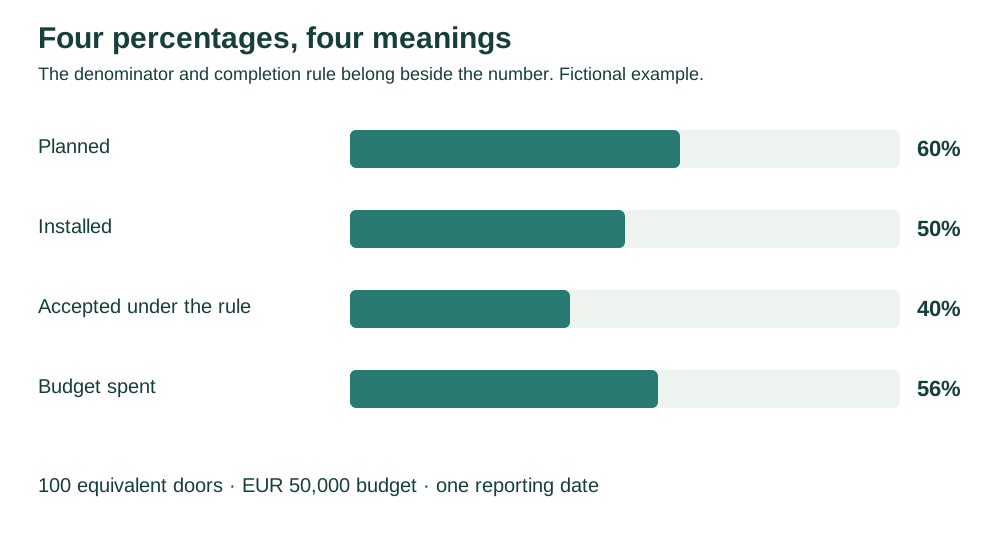
In this fictional work package, 100 equivalent doors have a total budget of EUR 50,000. The agreed progress rule credits a door only when installation and the specified check are complete. At the reporting date:
- The baseline plan called for 60 completed doors.
- 50 doors have been installed, but only 40 meet the agreed completion rule.
- Actual cost for the measured scope and period is EUR 28,000, including the appropriate recorded costs rather than only paid invoices.
Physical installation is 50%. Credited completion is 40%. Spending is 56% of the budget. Planned completion is 60%. Each describes something different; none should be relabelled as the others.
Calculate value using budgeted rates
The simple budgeted value per door is EUR 500. Planned value, or PV, is 60 × EUR 500 = EUR 30,000. Earned value, or EV, is 40 × EUR 500 = EUR 20,000. Actual cost, or AC, is EUR 28,000.
Cost variance is EV − AC = minus EUR 8,000. Schedule variance is EV − PV = minus EUR 10,000. The latter is expressed in budgeted value, not days of delay. To understand the completion date, examine the actual programme, sequence and remaining constraints.
The cost performance index is EV / AC ≈ 0.71; the schedule performance index is EV / PV ≈ 0.67. These ratios describe this example at this date. They do not prove the final overrun or predict a finish date by themselves. The definitions follow the NSF EVM Gold Card.
| Measure | Calculation | Result |
|---|---|---|
| PV | 60 × EUR 500 | EUR 30,000 |
| EV | 40 × EUR 500 | EUR 20,000 |
| AC | Recorded actual cost | EUR 28,000 |
| CPI | 20,000 / 28,000 | 0.71 |
| SPI | 20,000 / 30,000 | 0.67 |
| Schedule variance | 20,000 − 30,000 | −EUR 10,000; not days |
Agree the earning rule before reporting
A 0/100 rule suits short items that are either completed or not. Longer activities may need weighted milestones, such as approved design, fabrication, installation and testing. Define their weights, evidence and responsible reviewer before work begins.
Do not award the whole installation value merely because materials arrived unless the baseline deliberately assigns a separate, justified procurement milestone. Otherwise purchased materials can make a delayed installation appear healthy.
Connect each credited item to its inspection evidence, and record contractual certification and statutory reception at their own agreed stages.
Combine packages with meaningful weights
An inexpensive activity at 100% and an expensive activity at 0% do not necessarily make the project 50% complete. If their budgets are EUR 10,000 and EUR 90,000, respectively, the combined budget-weighted earned progress is 10%.
Even that weighting answers a cost-weighted question, not every physical or operational question. Report critical milestones separately: power available, safety systems tested, rooms usable, documentation delivered. A high overall percentage can coexist with a missing dependency that prevents occupation.
Turn the result into an action
For the door package, investigate the ten installed but uncredited doors. Are checks simply waiting to be recorded, or is corrective work needed? Identify the bottleneck, owner and next review date. Keep rework and changing scope visible; revise the baseline only through the agreed control process.
A useful report states: measurement date, scope, rule, planned and actual quantities, cost basis, remaining work and limitations. That gives the reader a way to challenge the number and decide what to do next.
Enable JavaScript to use reading progress and usefulness ratings.