
What an indoor CO₂ monitor can—and cannot—tell you
Use trends, occupancy and sensible placement to investigate ventilation, without treating one number as a certificate of healthy air.
A CO₂ monitor can make an invisible ventilation problem easier to investigate. Its value comes from a pattern: how readings change as people enter, windows open or the ventilation system changes operation. One isolated number, without context, is a poor basis for judging a room.
CO₂ is carbon dioxide. It is different from carbon monoxide, CO. A normal indoor CO₂ monitor does not replace a carbon-monoxide alarm or a specialist instrument for hazardous atmospheres.
What the evidence supports
ASHRAE's 2025 position document explains that CO₂ can inform ventilation assessment but is not a comprehensive measure of indoor air quality. It also reviews inconsistent findings on direct cognitive effects at concentrations encountered indoors. It does not justify turning a consumer reading into a diagnosis or a universal productivity-loss percentage. ASHRAE position document.
In an ordinary occupied meeting room, people are a source of CO₂. Its accumulation can help identify a mismatch between occupancy and outdoor-air supply. The interpretation changes where other sources, unusual air distribution or different activities dominate. A small office and a large industrial space should not be assessed as if they were identical.
Choose and position the instrument sensibly
UK HSE guidance recommends NDIR instruments for this purpose, placement around head height, away from windows and supply openings, and more than 50 cm from people. It advises representative repeated readings. HSE: using CO₂ monitors.
Check whether the device actually measures CO₂ or reports an estimated “equivalent CO₂” derived from another sensor. Read its accuracy range, warm-up instructions and calibration requirements. Do not assume an attractive display or an “air quality” label establishes measurement quality.
Put the device where it represents the occupied area without being breathed on directly. Record its position. If you move it halfway through an experiment, the resulting change may reflect the new location rather than better ventilation.
A worked investigation in a meeting room
Suppose eight people use a fictional meeting room for an hour. A log shows 480 ppm before occupancy, 900 ppm after twenty minutes and 1,450 ppm near the end. The ventilation setting, door position and occupancy are recorded alongside the readings.
This is a reason to investigate how outdoor air is supplied during occupation. It does not establish the cause of a headache, prove infection risk or identify a broken fan. Check the operating schedule, blocked openings, occupancy assumptions and whether the system is supplying outdoor air rather than merely recirculating it.
Repeat the observation under comparable conditions after an appropriate operational adjustment. If fewer people attend the second meeting, note that change; a lower reading cannot then be attributed solely to the adjustment. Keep comfort, external pollution and the building's safe operating arrangements in view when considering window opening.
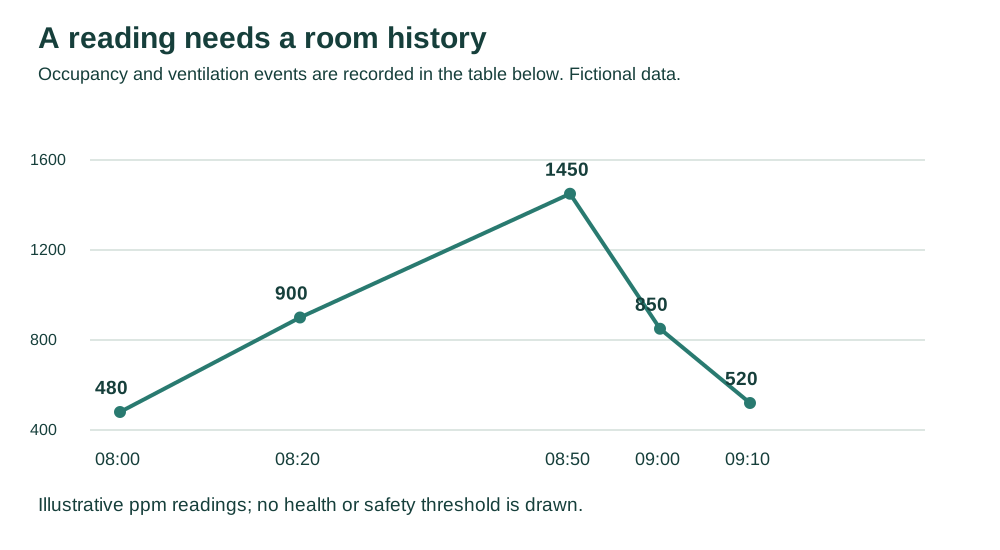
| Time | CO₂ (ppm) | Context |
|---|---|---|
| 08:00 | 480 | Before eight people enter; baseline ventilation setting recorded |
| 08:20 | 900 | Eight occupants; door closed |
| 08:50 | 1,450 | Eight occupants; investigate ventilation operation |
| 09:00 | 850 | Illustrative follow-up after increased ventilation |
| 09:10 | 520 | Room empty; ventilation continues |
Use thresholds as prompts with a stated context
HSE identifies readings consistently above 1,500 ppm in an occupied room as an indication of poor ventilation requiring action. Its guidance also warns that readings are only a broad guide, not proof of a safe level. Do not present that UK workplace guidance as a universal legal limit for Romanian buildings.
For your own monitoring plan, define who reviews repeated elevated readings, what operating checks follow and when a ventilation professional is consulted. A coloured “green” display should not end the investigation if occupants report persistent problems or other evidence points to a concern.
Know what the monitor misses
A low reading does not establish that fine particles, volatile organic compounds, moisture or mould are controlled. A particle filter can improve particle removal without reducing CO₂; the CO₂ trend alone therefore cannot measure that filter's benefit. Conversely, acceptable CO₂ does not prove that all relevant pollutants are low.
Avoid deriving an exact outdoor-air flow rate from a casual snapshot. Such calculations need assumptions about sources, occupancy, mixing, outdoor concentration and whether the conditions support the chosen model. Measurement uncertainty also matters when comparing small differences.
Keep a log that supports a decision
For a first review, record room, instrument, position, time, occupancy, activity, ventilation setting, window and door state, and the observed trend. Add the action taken and the result of the repeat observation. Preserve uncomfortable or contradictory readings rather than selecting the lowest value for a report.
The useful outcome is a better understanding of how the room is operated and when further assessment is needed. The monitor is one source of evidence within that process.
Enable JavaScript to use reading progress and usefulness ratings.