
Document Control Basics for Any Organization
Keep documents identifiable and trustworthy with practical numbering schemes, revision examples, review rules and a simple document register.
Information only — not legal advice.
Document control helps people identify the right document, understand its status and trace how it changed. It applies to policies, drawings, contracts, procedures, meeting minutes, research reports and other important information.
A useful process answers six questions: what is this document, who owns it, which revision applies, what may it be used for, who authorized it and who received it? The detail should match the consequences of using the wrong information.
Keep identity, revision and status separate
- Document identifier: a stable reference to the logical document, such as
ORG-POL-0007. - Revision: an identifiable content issue, such as
R03. Earlier revisions remain part of its history. - Status or purpose: whether the issue is a draft, under review, authorized for a stated use or superseded.
- Title: a readable description, such as Travel and Expenses Policy.
The identifier normally stays the same through revisions. A revision number by itself does not prove approval. A system's automatic save version may also differ from the revision formally issued to recipients.
Start with a simple numbering scheme
Here is an illustrative company convention, not a mandatory standard:
SCOPE-TYPE-SEQUENCE
ORGmeans organization-wide;LIBmeans the fictional library project.POLmeans policy,PROprocedure,DRWdrawing,MINmeeting minutes andREPreport.- A four-digit sequence, such as
0007, keeps sorting predictable. Decide whether numbering restarts by scope and type, and record that rule.
Examples:
ORG-POL-0007— Travel and Expenses Policy.ORG-PRO-0012— Supplier Approval Procedure.LIB-DRW-0012— First-level Lighting Layout.LIB-MIN-0021— Coordination Meeting 21 minutes.LIB-REP-0004— Commissioning Report.
Each meeting record gets its own identifier; correcting those minutes creates a revision of that same record. Do not reuse a withdrawn identifier for an unrelated document. For a very small organization, a shorter scheme such as POL-007 may be enough.
Make exported filenames understandable
A filename can carry the stable identifier, revision and issue purpose:
ORG-POL-0007_R03_ISSUED.pdfLIB-DRW-0012_R02_REVIEW.pdfLIB-MIN-0021_R01_ISSUED.pdf
If a date is useful, use an unambiguous form such as 2026-10-02 and keep it in the same position. For example, LIB-MIN-0021_R01_2026-10-02.pdf. Explain whether that date is the meeting date or issue date; they may differ.
Avoid names such as final-final-new.pdf. Keep filenames reasonably short, avoid unnecessary personal data and check the receiving system's character and path limits. The register should carry richer metadata than the filename. NARA's file-naming guidance provides further examples of consistent naming; its transfer-specific rules are not universal requirements for every organization.
Follow one policy through a revision
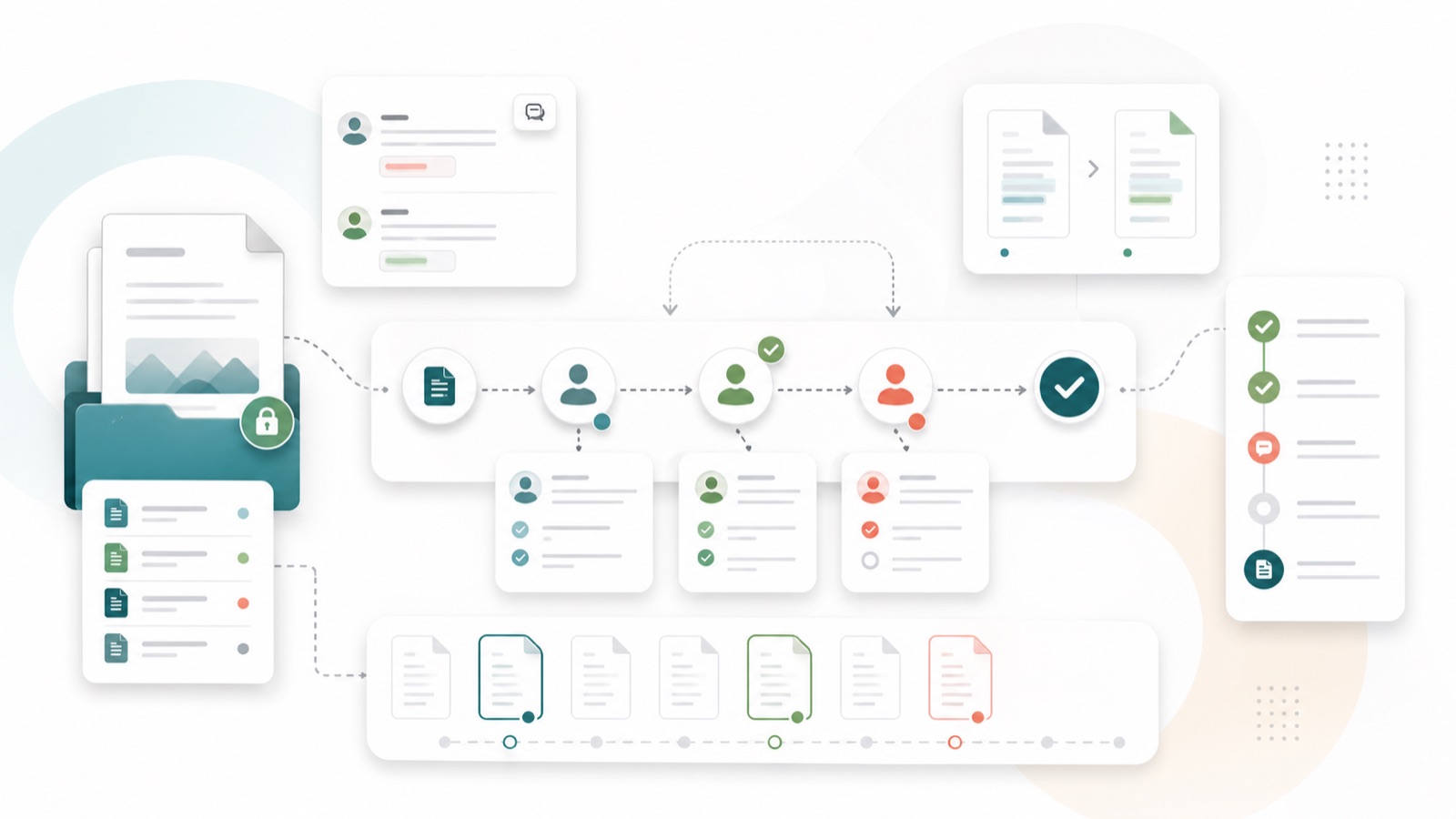
Fictional example: ORG-POL-0007 R02 is the current issued travel policy. The finance team proposes different approval limits.
- The owner prepares draft
R03and records the reason for change.R02remains current while the draft is reviewed. - Reviewers check the content and return comments. The owner records how the comments were resolved.
- The authorized approver accepts
R03, with an effective date of 1 November 2026. - The issue record identifies
R03, its approver, issue date, effective date and recipients. Before the effective date, readers can distinguish the current policy from the forthcoming one. - On the effective date,
R03becomes current andR02is clearly marked superseded. The old issue remains available to authorized people who need the historical evidence.
An editable source and its issued PDF should refer to the same document and revision. Check that the PDF was generated from the approved content. Do not silently replace an already-issued file with different content under the same revision.
Keep a small document register
Start with identifier, title, owner, revision, status, permitted use, approver, issue date, effective or review date, current-file location and superseded reference. Add a distribution or transmittal reference when you need evidence of who received an issue.
For example: LIB-DRW-0012, First-level Lighting Layout, design lead, R02, Under review, coordination only, approval pending. A filename or progress percentage must not turn that draft into an instruction to build.
Separate the responsibilities
- Author: prepares the content and explains changes.
- Reviewer: checks technical or business suitability.
- Approver: has authority to accept the document for its stated use.
- Controller or owner: maintains identity, issue history, access and distribution.
One person may perform several roles where appropriate. Higher-risk information may need an independent check. Write down the rule rather than relying on an informal assumption.
Manage copies and close the loop
Direct people to a dependable current-document location. If someone receives a downloaded or printed copy, explain how to check whether it remains current. Merely writing “uncontrolled when printed” does not remove the need to manage information used for important work.
Review broken links, overdue reviews, missing approvals and unauthorized copies. Retain or dispose of superseded information under the organization's retention rules and applicable obligations. A controlled archive should remain searchable by identifier and revision.
For construction information, a project may prescribe a more detailed naming and status system. Follow its agreed requirements rather than treating the examples here as ISO 19650 codes. Continue with Common Data Environments, Project Workspace Setup and Meeting Minutes and Action Registers.
Important information
This article provides general information and does not constitute legal advice or replace a qualified professional's assessment of your circumstances. Laws, official guidance, standards and product features can change. Check current primary sources and the requirements applicable to your jurisdiction, contract and project before making decisions. Examples illustrate the discussion; they are not official rulings or instructions for a particular case. For legal decisions, consult a qualified lawyer; for technical or other specialist matters, consult the responsible professional.
Enable JavaScript to use reading progress and usefulness ratings.