
How to Build a Simple Records Management Process
A practical records-management pattern for identifying records, assigning owners, controlling versions, and reviewing retention.
Information only — not legal advice.
A record preserves evidence of an activity or decision. It may be an accepted drawing, signed agreement, inspection result, purchase approval or a complete exchange of messages. Its value comes from the content and the context needed to understand it later.
Records management covers creation, capture, use, retention and disposal. Saving a file is only one part of that process.
Decide what needs to become a record
Identify events that require dependable evidence: a deliverable is issued, a decision is approved, goods are received or a complaint is resolved. Define which materials and metadata must be captured at each event.
Useful metadata includes a stable identifier, title, creator, date, business process, related project, revision or status, and any access or retention rule. Preserve relevant attachments and relationships. An email saying “accepted” is hard to interpret after its attachment has disappeared.
Avoid retaining every working copy indefinitely. Distinguish temporary working material from evidence that your business, contract or applicable law requires you to keep.
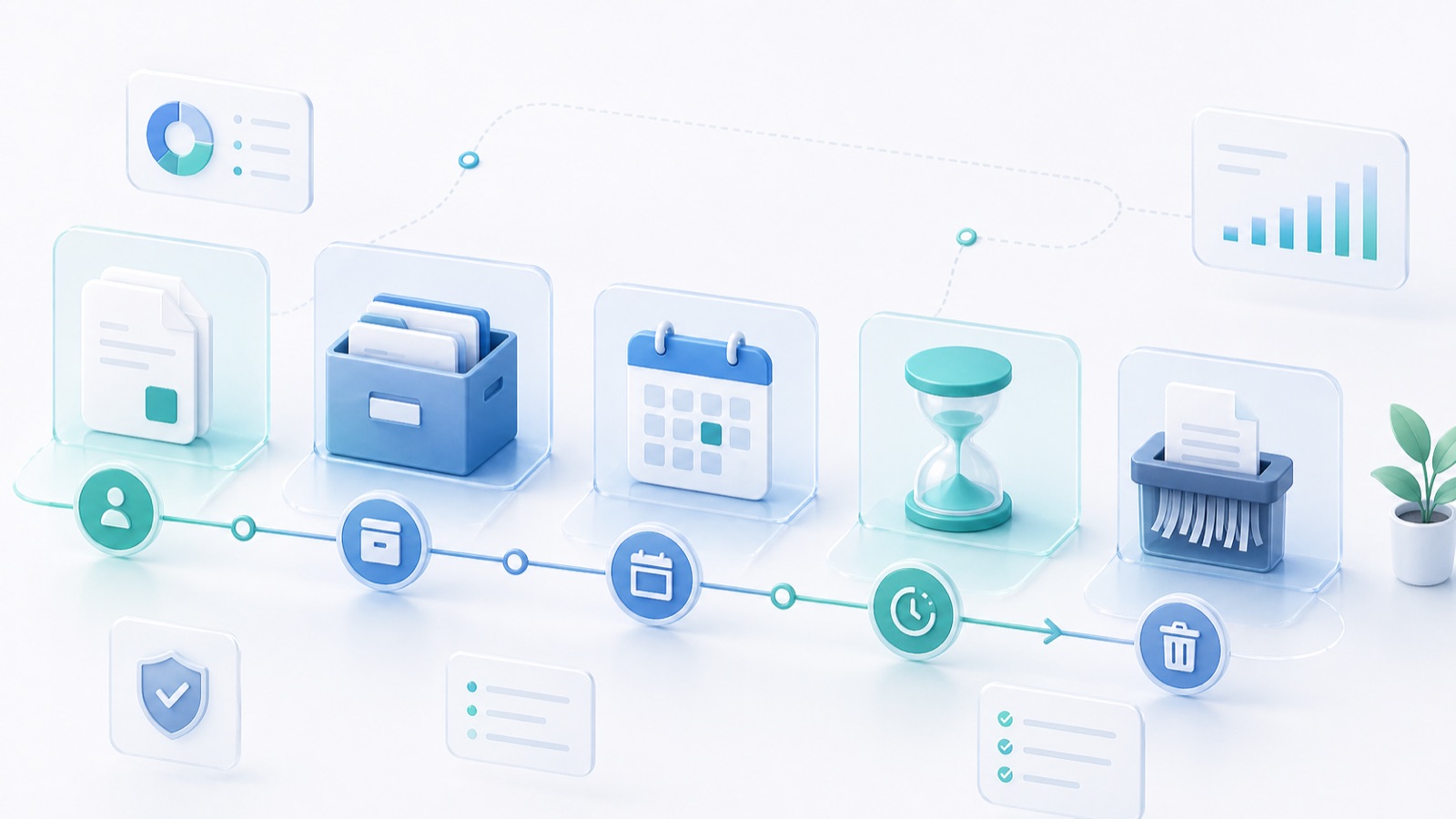
A practical lifecycle
- Create or receive: identify the activity and responsible person.
- Capture: save the record in the agreed location with its context and attachments.
- Protect and use: control changes and access while keeping it retrievable.
- Review retention: calculate from the defined event, such as contract closure, rather than an arbitrary upload date.
- Dispose or preserve: check holds and other obligations, obtain the required authority, and record what happened.
A record can legitimately need a correction. Preserve the original evidence and identify the correction, its reason and authority rather than silently rewriting history.
Example: closing a maintenance job
A fictional facilities team replaces a pump. Its record package contains the work order, equipment identifier, technician's report, commissioning measurements, applicable safety checks and the acceptance decision. Photos are linked to the equipment and date; the warranty document is accessible from the same record.
Six months later, a different technician can establish what was replaced and which readings were accepted. A folder containing only “pump-final.pdf” would not reliably provide that context.
Before archiving the job, the team checks that links still work outside the original author's account and that required formats remain readable. It assigns retention based on the relevant obligations and business need; there is no universal period that fits every maintenance record.
Retrieval and migration are part of the job
Test retrieval using a real question: “Show the accepted inspection for this asset on this date.” Search should work from the information users actually know. Restrict confidential records without hiding their existence from authorised custodians responsible for retention.
Before moving systems, reconcile record counts, attachments, identifiers and relationships. Open a sample of migrated files and compare important fields. An export that contains documents but loses their approval history may not preserve the evidence you need.
Check the result
A useful record is identifiable, understandable, protected against unauthorised alteration and accessible to authorised users for as long as required. A backup supports recovery; it does not replace classification, retention decisions or a record index.
ISO 15489-1 describes records-management concepts across formats and business environments. This article's maintenance example is an illustrative workflow. Continue with retention and deletion and audit logs.
Important information
This article provides general information and does not constitute legal advice or replace a qualified professional's assessment of your circumstances. Laws, official guidance, standards and product features can change. Check current primary sources and the requirements applicable to your jurisdiction, contract and project before making decisions. Examples illustrate the discussion; they are not official rulings or instructions for a particular case. For legal decisions, consult a qualified lawyer; for technical or other specialist matters, consult the responsible professional.
Enable JavaScript to use reading progress and usefulness ratings.